September 3rd, 2009

Chef Sandy’s Steak Primer

By Dena P

pic-2-beef-steak

School is back  in session so what better time to brush up on a lesson that is near and dear to my heart?  Yes, class, it’s time for a lesson on steak.

Chef Sandy goes through the ins and outs of cuts for us here. And if you pay attention you might just get an extra recess.

I often get the question, “What kind of steak should I buy?”

Well, that kind of depends on a few factors…

            -What do you want to spend?

            -What sort of texture do you want?

            -What is the doneness level that you prefer?

            -What kind of fat percentage do you want?

            -What cooking method are you planning to use?

Here is a brief overview:

Many of the cuts of beef that are used for steaks are cut from the loin portion of the beef.

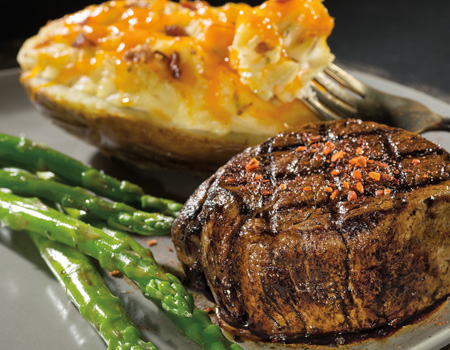
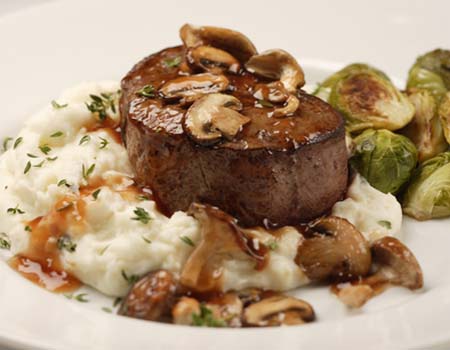
Most of us are well aware that filet or beef tenderloin (and Chateaubriand) are all part of the same very expensive cut of beef.  There is very little waste, very little work for the cook (little trimming is necessary) and it is appropriate for anything and anyone who likes steak, even at the fanciest meal.  The texture of tenderloin is very tender, and some say that the flavor is not assertively beefy enough, but that is really a matter of choice. 

Many times this cut of meat will be served with a sauce or an equally luxurious topping like a bleu cheese topping or it will be wrapped in bacon, all of which will enhance the flavor. This is the priciest cut of steak, but again, there is no waste, and not too much shrinkage, so what you buy (and pay for) is what you get to eat.

But what is the difference between a T-bone and a Porterhouse?  How about a KC Strip and NY Strip?

A Porterhouse is a steak with a T-bone in the middle, and a large portion of both tenderloin and strip loin.  A T-bone is the same steak, but the tenderloin portion is usually smaller than a silver dollar, or even non-existent.  The bone-in nature of this steak usually yields great flavor, and oftentimes at the grocery store the T-bones actually have a large filet portion (and should therefore be labeled as the more expensive Porterhouse — shh, we won’t tell). 

The difference between a KC Strip and a NY Strip is basically a marketing difference.  Depends on where you are from.  Either could come with a bone, but often not, and both are a generally oblong shaped steak, with not much visible marbling, but fat around the outside (non-bone side) of the meat.  Depending on where you shop, and what part of the country you are from, these steaks are often in the high-middle of the price range for quick cooking steaks.

A ribeye or Delmonico steak is well marbled with fat, and because of its high fat content, can be cooked more well done and still remain juicy.  This kind of steak will flame up on the grill, so it should definitely be watched carefully.  One trick I have used is to first grill the steak on the grate to get grill marks (and flavor) and then put heavy duty foil on the grill and put the steaks on top to finish cooking them without incinerating them.

Sirloin steaks on the other hand, may need marinating to become juicy.  They should not usually be cooked to more than medium doneness and oftentimes are sliced thinly against the grain for presentation to help ensure a tender dining experience.  Flank steak and skirt steak (fajitas) are also cuts of meat which should be marinated, cooked quickly to a med-rare or medium doneness and sliced across the grain for tenderness.

Round steaks are usually too tough to use a direct cooking method, and are better suited to another preparation method like braising — think Swiss steak.  Brown, then cook the steak until tender in flavor liquid (gravy) for a few hours.  Many different cultures have variations on this theme, and a thin round steak can also be used as a wrapper for flavorful ingredients, with the whole bundle braised in flavorful liquid for a delicious meal.  Italians call it Braciole (may also be made with flank steak) Germans have Rouladen.  Long story short, braise it for great taste and tenderness.

If you are making Chicken Fried Steak, the traditional choice is a tenderized round steak.  This is a piece of meat which has been put through a process which mechanically pounds the steak and breaks up the tissues with thousands of little blades.  This is the only way to use this steak in a quick cooking manner, otherwise you would end up with shoeleather.  I have seen Chicken Fried Ribeye and Chicken Fried Filet on some fancier menus here in Texas, and since these are more tender pieces of meat, no mechanical tenderizing is necessary. Tasty, and about as decadent as you can get…

If you have any questions about a piece of meat you are considering buying, just ask.  At many grocery stores or even Web site, sometimes they have flip guides to cuts of meat and preferred cooking method, and sometimes even stickers on the actual meat packages which say “Great for the Grill” or “Best for Braising” or some similar catchy tips.  Or better yet, try some new choices next time you go to your favorite steak restaurant, and make a note to yourself about what you like and the preparation methods you enjoy.

Then you can try them out at home!

Photo courtesy of acjc.edu.


December 8th, 2008

Holiday Meal Planning

By Dena P

It’s time to start thinking about what to serve for those family holiday get-togethers. And nothing satisfies better than an elegant beef tenderloin.

Also known as Chateaubriand, there are so many ways to prepare this tasty dish. This one’s an absolute crowd-pleaser . . .


Garlic and Sage Basted Chateaubriand

Ingredients:
1 32 oz. Chateaubriand
1 lb. Butter
3 Cloves Garlic, crushed
1 bunch sage leaves, stems and all
Salt and Pepper
Directions: In a heavy saucepan, melt the butter over medium heat. Add the garlic and sage and continue to cook until the butter brownish caramel color and has a wonderful, nutty aroma. Turn the heat to low and keep the butter warm. In a heavy bottomed pan, sear the roast on all sides, before placing in a hot (400 degree) oven, use a spoon to liberally baste with the brown butter. Cook for twenty minutes, basting again every four to five minutes until done or an internal read thermometer reads 155 degrees. Remove from the oven and lest rest ten to fifteen minutes. Slice and serve with a little of the brown butter on each plate.
Servings: 4
Source: KC Steak CompanyPhoto courtesy of MyRecipes.com.

November 11th, 2008

Dauphinoise Potatoes

By Dena P

Sandy mentioned previously a delicious side that would complement a Chateaubriand or, really, any beef entree.

I love an alternative to my usual potato sides. This recipe for Dauphinoise Potatoes is not only tasty, but truly gorgeous. Here is what it looks like when Sandy prepares it . . .

Yeah. Spectacular.

You can brush up on your gratin family of potatoes history here. In the meantime, here are Sandy’s step-by-step instructions so we can be JUST LIKE HER . . .

Recipe for Dauphinoise Potatoes:

1 pint heavy cream or half and half
garlic, herbs or flavoring as desired
kosher salt and pepper
6 medium baking potatoes, peeled
2 Tablespoons Butter

Preheat oven to 400 degrees.

Bring cream or half and half to a simmer in a medium saucepan, adding whole peeled and smashed garlic cloves (2 for subtle garlic flavor), herbs such as thyme or rosemary sprigs to flavor the liquid.  When the cream develops small bubbles on the rim of the saucepan remove from heat and set aside until potatoes are prepared. Add 1 teaspoon kosher salt and several grinds fresh pepper.  Taste the mixture for seasoning.  It should be slightly saltier than you would eat straight (potatoes absorb lots of salt). 

With 1 tablespoon of softened butter, grease the potato baking pan(s) generously.  Wash, peel and thinly slice potatoes, preferably using a mandolin-type slicer with a sharp blade.  1/8 in slices are ideal and easy to do with a slicer.  Slice potatoes directly into baking dish.  I used a loaf pan but any pan which will allow the potaoes to cook in a deep layer (ie lots of head room) will work.  Individual tart pans can be used to bake and serve directly.  Toss the raw potatoes with about 1 1/2 teaspoons of kosher salt and some pepper.  Strain the liquid or just remove herbs and garlic.  Add to baking dish, you will probably not need all of the liquid, depending on the size of potatoes, the baking dish and how much reduction of liquid took place.  Potatoes should be nearly covered, but not swimming in cream.

Use plastic wrap to push the potatoes down into the liquid.  Place plastic wrap directly on the surface of the potatoes.  Cover pan and plastic wrap with foil and weight the potaoes down with a slighly smaller pan filled with hot water.  Place the baking dish in the oven for 40 minutes.  Carefully remove the water filled pan, the foil and the plastic wrap and continue to bake until the potaoes are tender and the liquid is nearly absorbed.  Some thickened liquid will remain.

If you are serving immediately, place the pan under the broiler and cook until potatoes are golden.

If you are preparing this dish ahead, cover and let cool in refrigerator.  When totally cool, potatoes may be turned out of baking dish onto cutting board and cut with a sharp heavy knife into serving sizes.  Place on well buttered baking pan.  To reheat, place in 450 degree oven until browned and hot throughout.  Serve immediately.


October 24th, 2008

Béarnaise, Anyone?

By Dena P

One of Sandy’s suggestions for a lovely accompaniment to the elegant Chateaubriand is a savory béarnaise sauce.

It’s a traditional sauce for any kind of steak or beef, but it’s especially appreciated on a beautiful cut of beef like Chateaubriand.

Here’s what she said . . .

A quick béarnaise recipe adapted from Craig Claiborne’s The New York Times Cook Book: (the tarragon reduction is exactly what I remember from making this sauce in much larger quantities in cooking school).

2 tablespoons white wine

1 tablespoon tarragon vinegar

2 teaspoons chopped fresh tarragon

2 teaspoons chopped shallot or onion

1/4 teaspoon pepper

In a small saucepan, bring the ingredients above to a boil and cook until almost all of the liquid disappears.  This will only take a few minutes, and will be very strong smelling (i.e. don’t put your nose directly over it).  This is the typical flavoring agent of béarnaise and can be added to 1 cup of your favorite hollandaise, or use the following to create that:

Place 3 egg yolks, 2 tablespoons lemon juice, 1/4 teaspoon salt and a pinch of cayenne pepper in a blender container.  Combine by pulsing the motor on and off until combined and frothy.  Never let acid (lemon juice) or salt sit on raw egg yolks without mixing them in – it will “cook” the egg yolks and give you unwanted lumps in your sauce. 

Add one stick unsalted real butter to the herb mixture sauce pan and heat to bubbling, not browning.  Remove from heat.

Turn the blender back on and blend the egg yolk mixture until frothy and lighter colored, then with the blender running carefully add the hot herb/butter mixture to the yolks and blend on high speed for 4 seconds. 

Remove to clean thermos container unless you are ready to serve immediately.

This sauce cannot be reheated, or it will break (separate).

Very traditionally, this sauce would be served alongside the Chateaubriand in the (cooked and warmed) heart of an artichoke for each person. 

I love how Sandy always walks me through the landmines I might encounter — like putting my nose directly over the bubbling sauce. I would have totally done that.

And the storing of the sauce in a thermos until the meal is ready to be served is pure genius. I would not/could not have come up with that sauce-saving technique.

Try this graceful sauce served in lovely artichoke hearts with your next beef-featured meal and let me know how it turns out for you!

Photo courtesy of uktv.co.uk


October 22nd, 2008

Chateaubriand with Duxelles

By Dena P

Today I bring you another installment from my Jedi master of cooking, Sandy. Check out this post to get the whole story on our journey through Chateaubriand-land.

In this episode, Sandy sends me advice on how to prepare my Chateaubriand stuffed with duxelles.

She didn’t send it by way of Jedi mind tricks — just good ‘ol e-mail.

-Chateaubriand may be split and stuffed with duxelles (a mushroom and herb mixture) before cooking.  Finely dice about 1/2 pound of mushrooms, either white or shiitakes or a combination of your favorites.  Use a food processor if you want, little pieces are good, just not paste.  Finely mince 1 shallot, saute in 1 tablespoon butter in medium skillet until translucent.  Add mushroom mixture, 1/2  teaspoon salt and a few grinds of pepper and cook over medium high until the mushrooms give off their liquid and the liquid cooks off and they look dry again.  Remove from heat.  Add 1-2 chopped herbs, such as Italian parsley if desired.  Let cool to room temp.   Meanwhile, use a sharp knife to cut a 1 inch slit down the length of the meat.  Add the cooled mushroom mixture and roll back into roast shape, tying as necessary. 

-Then roast at a high temperature (450) to medium doneness (or less).  I would only use olive oil, salt and pepper to season.  You may tie rosemary in the trussing string which would give it a little herbal taste.   Rare is 125-130.  Medium is 140.  Use an instant read thermometer or better yet, an electronic (ie the Polder) with the probe stuck in the middle the whole time.  After about the first ten minutes, baste the roast with addl olive oil or pan juices if it looks dry.  Toss the shallots (if you chose to create a bed of them on the bottom of the pan) to promote even browning.  A 2.5 pound roast should take about 30-40 minutes to reach rare doneness. 

A duxelles will give your Chateaubriand more texture, interest and flavor. And, man, will your guests be impressed. For more on duxelles, including alternate recipes and uses, check out its Wikipedia description here.

Bon Appetit!


October 20th, 2008

My Own Personal Yoda

By Dena P

I’m a pretty basic cook.

I can cook some great meals, but I don’t stray too far from what I know. I’m not usually very adventurous because I’ve failed a few times at new things. See the Salisbury Steak debacle.

However . . . I have a sister-in-law, Sandy, who is an accomplished cook with an Associate of Arts degree in the Culinary Arts from the Scottsdale Culinary Institute. She’s worked at the Ritz-Carlton in Phoenix, among other schmancy places, preparing filet mignon and other delights for hundreds of people at a time. She also has an MBA and she’s married to my brother, but that’s another story.

Our family taps into Sandy’s expertise every chance we can get. You can imagine who takes the lead in the kitchen at family gatherings. And every time I cook something with her I learn something new.

So it was time for me to branch out and I wanted to try Chateaubriand. I knew I could do it but I needed some guidance. And some step-by-step instructions.

I cried out, Help me, Obi-Wan! And the result was some e-mails from the master that are like gold to me.

Here’s a little preview . . .

Yeah, I did that. But I needed some help. So here’s what Sandy told me to do (in bold):

First thoughts on Chateaubriand-

-It is the center of the tenderloin of beef, the most delicate part

-In a restaurant, it is usually served as a portion for two people

-It is usually fairly uniform in size but may be tied to ensure even cooking.  You can get kitchen twine at the supermarket in the kitchen stuff aisle.  To tie, tuck in any narrow end and tie a square knot to start.  Go down about an inch on the meat, hold the string in place on the top of the meat, go around the bottom and loop or tie again.  It does not matter if you use proper technique or pretty knots, but if the meat is a uniform thickness it will cook evenly.

Note:  I did not do the twine because I actually felt like cooking it unevenly would be a good thing in my house. I like meat a bit more well done than my husband so I liked having both medium and medium well meat slices. For a dinner party, I’d definitely use the twine.

-Let the meat sit out for 1/2 hour before cooking in order to help even cooking throughout.  Preheat oven during this time to get it good and hot.  Season just before the meat goes into the oven.

-Use a roasting pan or heavy ovenproof skillet to cook the meat.  You may want to make a bed of shallots (member of the onion family) to the pan first if you want to make a pan sauce.  Shallots are much milder in flavor than onions and are a traditional accompaniment to delicate flavors like Chateaubriand. Peel the brown papery skin from about a pound of shallots (available next to the onions in most grocery stores).  Toss with a little olive oil in the roasting pan, until glistening (about 1 Tablespoon) and sprinkle with a teaspoon of kosher salt and some grinds of fresh black pepper.  Rub Chateaubriand with olive oil, season with salt and pepper too.

Shallots ready to be peeled in the front, fresh rosemary in back. Oh, the aroma!!

Shallots ready to be peeled in the front, fresh rosemary in back. Oh, the aroma!!

 -Traditionally it will be roasted at a high temperature (450) to medium doneness (or less).  I would only use olive oil, salt and pepper to season.  You may tie rosemary in the trussing string which would give it a little herbal taste.   Rare is 125-130.  Medium is 140.  Use an instant read thermometer or better yet, an electronic (ie the Polder) with the probe stuck in the middle the whole time.  After about the first ten minutes, baste the roast with addl olive oil or pan juices if it looks dry.  Toss the shallots to promote even browning.  A 2.5 pound roast should take about 30-40 minutes to reach rare doneness. 

Ready to be tented in foil. I cooked mine to 145 degrees - I like it a bit more well done.

Ready to be tented in foil. I cooked mine to 145 degrees - I like it a bit more well done.

-When the roast reaches doneness, use tongs to remove from the oven to platter and tent with foil to let the meat juices redistribute within the meat.  Reserve shallots to serving dish.  Add 1/2 cup of a good dry red wine and 1/2 cup homemade or low-sodium canned chicken stock to roasting pan and place over high heat to deglaze (remove brown bits from the roast and shallots which are stuck to the pan).  Stir constantly with a heatproof spoon or spatula until the mixture is slightly reduced and thickened.  Remove pan from heat.  At this point you may want to Monte’ au beurre the sauce, which simply means to whisk in a few teaspoons of very cold butter, about 1 teaspoon at a time, to the pan sauce which will thicken and give a richness to the sauce.  Strain into a warm, not hot, sauce dish (you can just put a microwave proof dish on the microwave for 30 seconds or so).

Traditionally served with a potato side, often a Gratin or Dauphinoise. 

I served mine with parsley potatoes -- just boiled, skinned potatoes pan sauteed in butter, chopped onions, kosher salt, ground pepper and chopped parsley. Magnificent!

I served mine with parsley potatoes -- just boiled, skinned potatoes pan sauteed in butter, chopped onions, kosher salt, ground pepper and chopped parsley. Magnificent!

So, dear friends, the moral of this story is that it is completely possible for us civilians to create an amazing meal if we have the right instructions.

And when my husband walked in our door to the smell of roasting shallots, beef drizzled in olive oil and fresh rosemary, he said he thought he had stepped back into the 1950s.

He then asked me to fetch his slippers, pipe and scotch on the rocks.

I told him to take a hike.

Nevertheless, we enjoyed such a good meal that he begged me to make it again. And I will. Only next time I will invite some people over to show them I really can make something great.

I think what made all the difference here (besides starting off with really high quality beef) were Sandy’s exact instructions. You’ll notice she told me where specifically to find the shallots in the supermarket and her cooking time and meat thermometer estimates were right on.  

Also, I’m pretty pleased that I can now Monte’ au beurre something. Just don’t tell anyone it’s really only whipping cold butter into the sauce.

And, since everyone doesn’t have a sister-in-law like Sandy, I’m willing to share mine. I’ll be posting lots more of our discussions in the future for your benefit, too.

Next time, I’ll share with you some other ways Sandy told me I could prepare my Chateaubriand (I got mine here), along with a bernaise sauce that might be right up your alley.

Update:  I have been informed that only half-wits refer to the sauce as “bernaise.” It’s béarnaise. Wikipedia told me so. My apologies to one and all.