If you’re feeling a little lost when it comes to cuts of beef — have no fear. I’ve found a great reference for cut types, beef grades and cattle types over at thefoodpaper.com.
Study these and you’ll be well on your way to a steak Ph.D!
Beef Cuts 101
A Simple Primer to Understanding Steak
Kobe, Angus or Piedmontese beef? Porterhouse, shell or flatiron steak? These days, going to a steakhouse is much more complicated than in the days when you chose from a New York strip, rib eye or filet mignon.
We’ll leave it to the cattlemen and women to sort out which is the best cut of steak. Meanwhile, we’ll take the bull by the horns and sort out all the terminology.
STEAK CUTS
___________________________
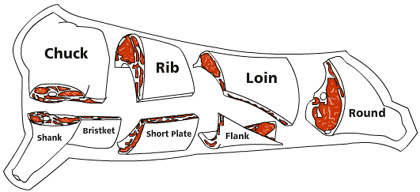
Picture the side of the steer. Starting at the neck and working down the backbone, you have the chuck, then the rib, followed by the short loin and sirloin and ending with the rump. The side section is the flank. Those areas produce the following steaks:
Chateaubriand: A piece of the tenderloin (the pointed end of the short loin), sized to feed two or more people and traditionally roasted.
Delmonico: A boneless cut from the rib section, named after the 19th century New York restaurant that popularized this dish.
Filet mignon: Think French! The name of this cut translates as tenderloin and it is the tapered, fork-tender end of the short loin.
Flank steak: A lean cut of meat taken from the underbelly that grills quickly. This cut often is used for fajitas.
Flatiron steak: Cut from the top blade, so named because it resembles a flatiron.
Hanger steak: Also called the hanging tenderloin, this cut is part of the diaphragm that hangs between the ribs and the loin.
London Broil: A large cut from the flank, often marinated to tenderize it, then broiled and served thinly sliced.
New York strip: A steak by many other names…(such as shell steak, Kansas City strip or sirloin club steak): The marbled, larger end of the short loin.
Porterhouse: Essentially the T-bone’s big brother, combining two steaks in one, the New York and the filet.
Prime rib: The bone-in rib steak, cut from ribs six through twelve, that often contains a bit of gristle but is full of flavor.
Rib-eye: A rib steak without the bone; prized among steak lovers for its marbling and flavor.
Sirloin steak: Sitting between the short loin and the rump steak is the sirloin, less tender than the short loin but still full-flavored.
T-bone: Similar cut as the Porterhouse, only the filet side is usually a bit smaller. Named for the t-shaped bone running down the center of the steak.
Tri-tip: Also known as a culotte steak or triangle steak, the tri-tip is a triangular-shaped portion of top sirloin.
BEEF GRADES
___________________________
The United States Department of Agriculture, or USDA, separates beef into eight different grades: Prime, Choice, Select, Standard, Commercial, Utility, Cutter and Canner. Most restaurants serve Prime or Choice beef and only about two percent of all beef graded by the USDA qualifies for Prime distinction.
Another grading program is Certified Angus Beef®, a designation awarded by Wooster, Ohio-based Certified Angus Beef LLC. The mark applies to approximately eight percent of all USDA-graded beef that derives from Angus stock and meets certain quality criteria.
Warning: Do not confuse Prime beef with the prime rib—the prime rib refers to the location from where the meat is cut, not the graded quality of the beef. The grades refer primarily to the amount of fat marbling in the muscle; Prime beef must contain no less than 8 percent intramuscular fat. And you wondered why it tasted so good?
CATTLE TYPES
___________________________
Gelbvieh, Piedmontese and Wagyu
Angu—Of Scottish origin, Angus cattle are prized worldwide for their well-marbled, meat-heavy carcasses.
Beefalo—A cross between a buffalo and any breed of cattle.
Brahman—A native of India, this breed has a distinctive back hump and can handle hot weather.
Braunvieh—A Swiss breed—how now, Brown Cow? Braunvieh means “brown cattle.”
Charolais—A French breed from Charolles, grown for meat, not dairy.
Chianina—A product of central Italy.
Gelbvieh—Originated in Bavaria, in southern Germany in the late eighteenth and early nineteenth century.
Hereford—Natives of England, this is a common breed in the U.S., Argentina and Australian for meat production.
Wagyu—The famed cattle that produce Japan’s prized Kobe beef, named for the city that launched the breed.
Piedmontese—A crossbreed from Italy’s Piedmont region; their breeders promote their meat as being naturally low in fat but still tender and flavorful.
Santa Gertrudis—A cross between a Brahman and a shorthorn, this breed is believed to be the first created in the U.S.
Senepol—A breed developed in the Caribbean, this one is heat-tolerant and meaty.
Simmental—A Swiss breed grown for both dairy and meat production.
Shorthorn—Originally from England, shorthorns are a popular American breed because they grow rapidly.
Image source: beef cut diagram from www.certifiedangusbeef.com; For more information, see also www.wagyu.org and www.kobe-beef.com.